侦探物语
China's earliest tinned iron armor found in Zhejiang: 1,700-year-old anti-rust tech revealed_我的网站

一 |  A股三大指数今日涨跌不一,截止收盘,沪指涨0.19%,深证成指跌0.35%,创业板指跌1%。
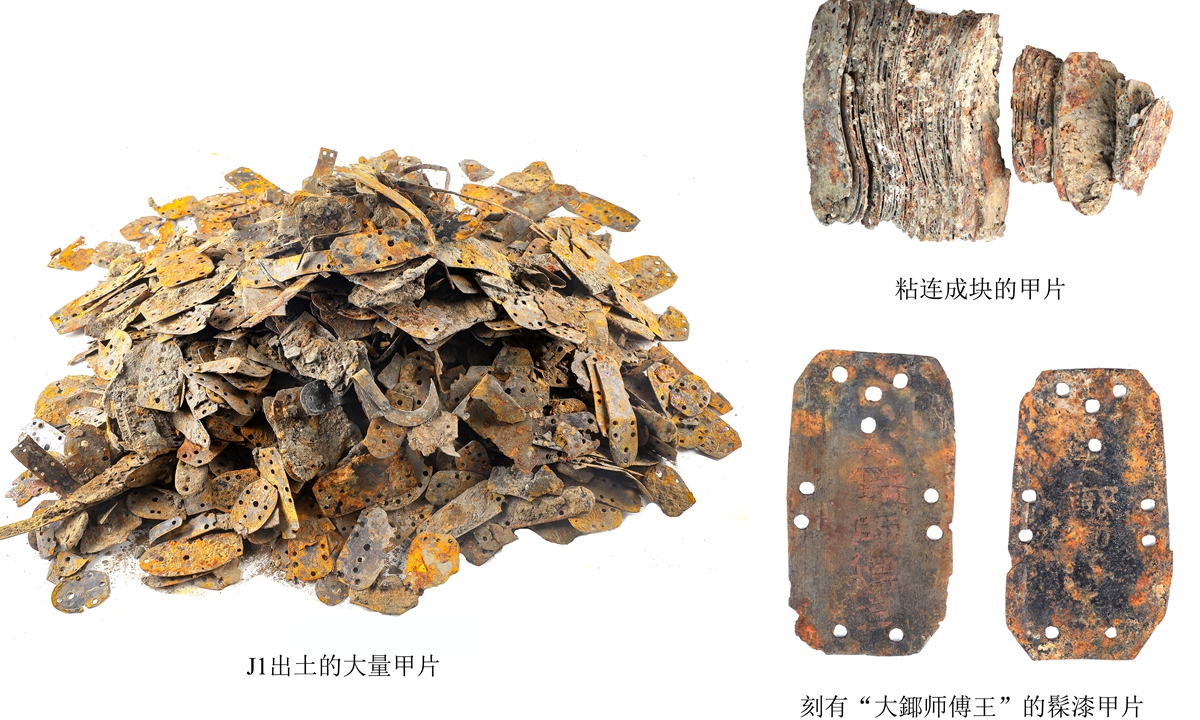
A number of tinned iron armor plates excavated from the Jizhong site Photo: Courtesy of the Shaoxing Institute of Cultural Relics and ArchaeologyArchaeologists at the Jizhong ruins site in Shaoxing, East China's Zhejiang Province, recently unearthed a large number of tinned iron armor plates and semi-finished pieces dating to the Wu period of the Three Kingdoms (222-280), according to the Shaoxing Institute of Cultural Relics and Archaeology. These discoveries represent the earliest known tinned iron artifacts in China to date, as well as the earliest tinned iron production remains found anywhere in the world, proving that an organized, systematic craft industry for tin-plated ironwork existed at that time.
While China has a long history of making tinned bronze and tinware, there has long been a lack of reliable historical records or physical evidence to prove early local production of tinned iron artifacts. The newly discovered armor plates can fill this gap, demonstrating that, by no later than the Wu period, local craftspeople in Zhejiang Province had mastered the art of tin-plating iron surfaces. This reflects the region's advanced metallurgical skills at that time, Ge Shuaikun, a researcher at the Shaoxing Institute of Cultural Relics and Archaeology, told the Global Times on Tuesday.
Over the last three years, archaeologists working at the Jizhong ruins site have excavated hundreds of tinned iron armor plates from ancient wells and ash pits. A preliminary investigation confirmed that the surfaces of these plates contain high levels of tin. Subsequent laboratory analyses were conducted in collaboration with the Shaoxing's institute and the Institute for Cultural Heritage and History of Science & Technology at the University of Science and Technology Beijing with methods such as Scanning Electron Microscopy with Energy Dispersive Spectroscopy (SEM-EDS), X-ray Diffraction (XRD), and Micro-CT to deeply examine the samples' materials, structures, and technological traces.
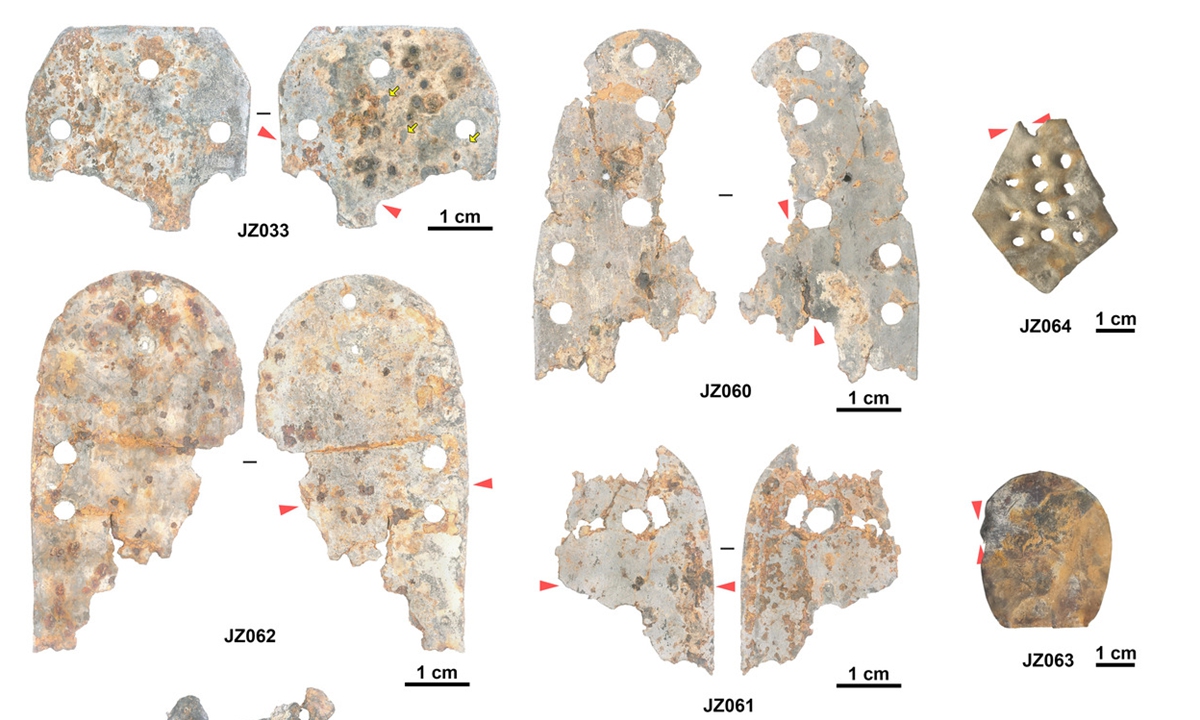
Photo: Courtesy of the Shaoxing Institute of Cultural Relics and ArchaeologyAccording to Ge, tin is a non-toxic metal with a low melting point, excellent corrosion resistance, and a silvery sheen. Tin plating effectively prevents rust, making iron armor far more durable and indeed, even after being buried for 1,700 years, many of these tinned plates retain their silvery metallic shine.
Research shows that the craftspeople immersed iron armor plates in molten tin, thus ensuring complete coverage of the surface with a continuous tinned layer. This coating isolated the iron from exposure to air and moisture, dramatically boosting corrosion resistance. Many of the excavated tinned armor pieces still show a clear, bright silver-white finish.
One major reason for tin-plating the armor was to prevent rust. At the same time, the silvery white shine of tinned iron offered a more striking, beautiful appearance, standing out from the typical dark iron armor of the era. This visual distinction may have marked these pieces as a higher-grade military asset, according to an article from the University of Science and Technology Beijing's official website.
The article said that in earlier eras, from the pre-Qin to Han dynasties, tin was widely used as a surface coating on bronzeware and ceramics. Researchers believe the tin-plating of iron armor discovered at the Jizhong ruins site during the Wu period of Three Kingdoms built upon this local tin-coating tradition, representing an adaptation of those techniques across different materials. The process likely benefited from technological exchange among various specialized workshops at the site, including those making bronze castings, iron weapons, and other metallurgical products.
。沪深京三市成交额仅1.84万亿,较昨日缩量近2000亿。行业板块多数收涨,地面兵装、装修装饰、酒店餐饮、房地产服务、一般零售、医药商业、航海装备板块涨幅居前,贵金属、能源金属、稀土板块跌幅居前。个股方面,上涨股票数量超过4200只,70只股票涨停。

二 |
根据TrendForce集邦咨询最新AIServer产业研究,在AI基础设施的建设浪潮下,以NVIDIA、AMD、Google为首的AI芯片持续迭代,单芯片的热设计功耗(TDP)普遍已超越1kW,整柜式AIServer方案的功率更攀升至数百kW,液冷散热逐步成为高端AI基础设施的标准配置。

三 | TrendForce集邦咨询预估,2026年液冷在AI芯片的渗透率将达53%,2027年有望逼近60%。 此外近日,根据国家市场监督管理总局(国家标准化管理委员会)公告,由中科曙光旗下曙光数创牵头编制的我国首部数据中心液冷国家标准——GB/T48023-2026《数据中心冷板式液冷系统技术规范》正式获批发布,并将于2027年2月1日起正式实施。这标志着我国数据中心液冷产业正式迈入标准统一、生态协同、创新加速的高质量发展新阶段。 公司消息上,8月24日,液冷龙头英维克(002837)发布2026年半年度报告,报告显示,2026年上半年,英维克实现营业收入30.2亿元,同比增长17.24%;归属于上市公司股东的净利润1.8亿元,同比下降14.32%。

四 | 有分析称,从二季度业绩来看,英维克一季度的利润大幅下滑并未延续,市场此前担忧的问题得到一定消解。 中金公司表示,全球AI算力芯片功耗加速突破风冷散热极限,数据中心向液冷架构演进,预计服务器液冷泵作为核心动力组件有望迎来放量周期。东吴证券指出,液冷已从可选散热方案升级为AI数据中心的刚性基础设施,VeraRubin全面量产标志着行业进入业绩集中释放期。国产液冷已由送样验证进入批量交付阶段,2026—2028年份额提升有望快于行业增长。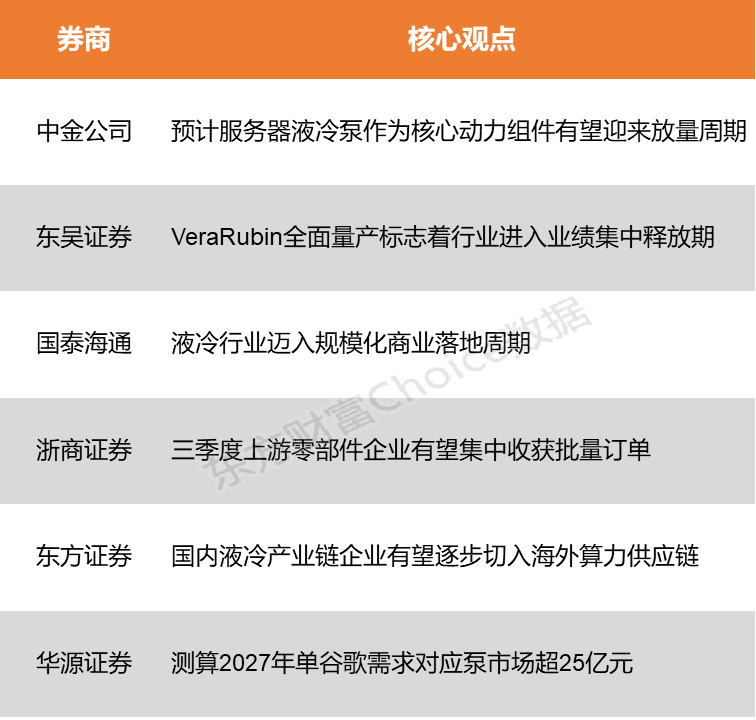 中金公司:预计服务器液冷泵作为核心动力组件有望迎来放量周期 全球AI算力芯片功耗加速突破风冷散热极限,数据中心向液冷架构演进,预计服务器液冷泵作为核心动力组件有望迎来放量周期。国内汽车热管理龙头依托精密电子电机控制、高压全密封等底层工艺跨界入局,展现竞争优势。 东吴证券:VeraRubin全面量产标志着行业进入业绩集中释放期 液冷已从可选散热方案升级为AI数据中心的刚性基础设施,VeraRubin全面量产标志着行业进入业绩集中释放期。国产液冷已由送样验证进入批量交付阶段,2026—2028年份额提升有望快于行业增长。

五 | 国内企业由外围冷源和代工环节逐步进入芯片平台、服务器ODM和海外云厂商供应体系。 国泰海通:液冷行业迈入规模化商业落地周期 液冷行业正式告别小规模技术验证阶段,迈入规模化商业落地周期。

六 | 随着英伟达Blackwell、Rubin新一代AI平台原生搭载液冷架构,国内云厂商、IDC运营商大规模新建智算中心,液冷订单正从零散试点向批量部署切换。 浙商证券:三季度上游零部件企业有望集中收获批量订单 英伟达VR200机柜大规模出货是核心驱动力,叠加各类液冷终端设备量产落地,三季度上游零部件企业有望集中收获批量订单。海外算力资本开支持续上调印证行业景气度:谷歌、Meta、亚马逊相继上调2026年AI资本开支指引,北美云厂商加大算力布局节奏明确。 东方证券:国内液冷产业链企业有望逐步切入海外算力供应链 随着搭载原生液冷架构的新一代芯片持续交付,全球液冷需求增长确定性较强,国内液冷产业链企业有望逐步切入海外算力供应链,打开全新增长空间。

七 | 华源证券:测算2027年单谷歌需求对应泵市场超25亿元 英伟达下一代800HVDC架构CDU拟采用高压直流电子屏蔽泵,谷歌2MWCDU方案确认可采用,测算2027年单谷歌需求对应泵市场超25亿元。 (本文不构成任何投资建议,投资者据此操作,一切后果自负。市场有风险,投资需谨慎。

八 | )(文章来源:东方财富研究中心)。
Current article:http://www.hanninhuaxituochunkui.pics/4ghpxhe/20260826/4171.xlsx
Published on:02:41:49