浪花一朵朵
Bangladesh's Gaibandha bypolls stopped: Poll body_我的网站

一 | Dhaka, Oct 12 (UNI) The Election Commission (EC) has stopped the by-election of Gaibandha-5 seat due to various irregularities and fraud in the polling station.
Chief Election Commissioner (CEC) Kazi Habibul Awal said this in a press conference on Wednesday.
The CEC said that polling was suspended in 51 centers due to various irregularities.
"Later we decided to stop polling in the entire constituency. That decision has been announced. There is no more voting. The vote will be decided later. Further decision will be taken after reviewing the law," Awal said.
UNI MAZ ING。
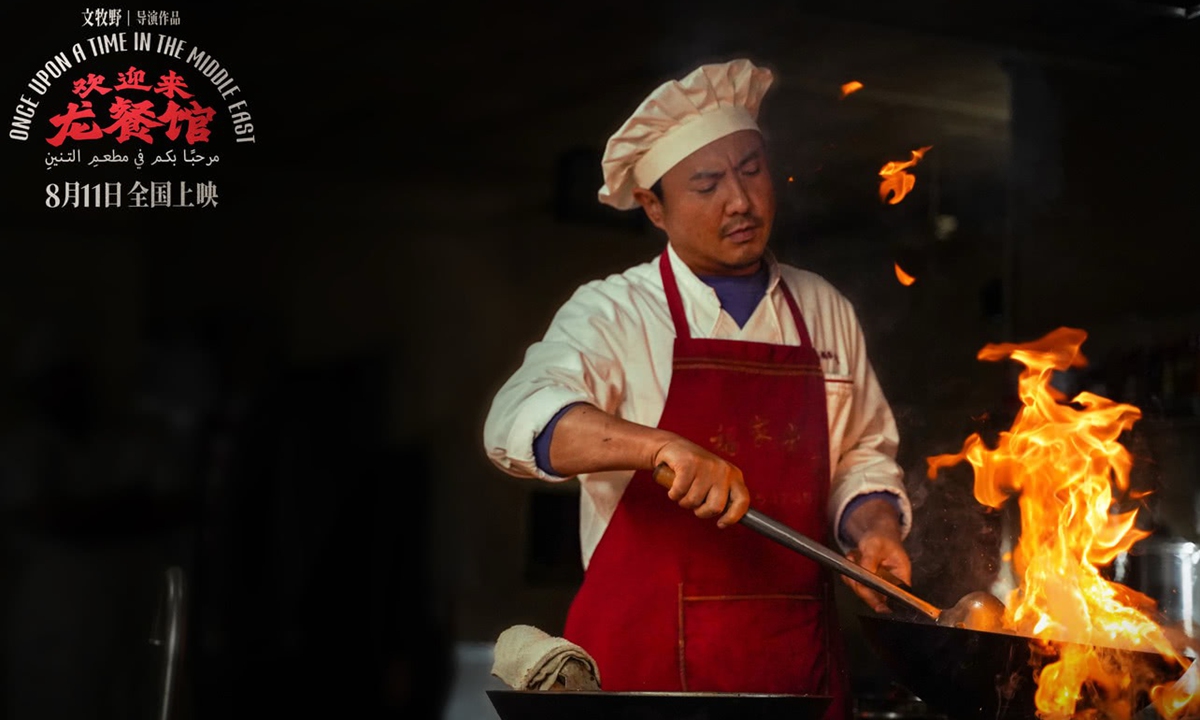
A still from the movie
Once Upon a Time in the Middle East starring Shen Teng Photo: ICYears after tackling social issues in the breakout hit film
Dying to Survive, Chinese director Wen Muye returns with
Once Upon a Time in the Middle East. The film opened nationwide in China on Tuesday, and, including advanced screenings, crossed 200 million yuan ($29.6 million) at the box office on its first day.
It centers on an ordinary Chinese chef caught in the crossfire of war. Shen Teng stars as Xu Fu, a cook who travels to the fictional Middle Eastern capital of Bahata to repay family debts. There he joins forces with restaurant manager Ma Junsheng (actor Jiang Qiming) to run a Chinese eatery. When conflict erupts, the self-preserving every-man endures personal losses and gradually comes to protect local children.
Produced by Ning Hao, the film continues Wen's signature focus on "little people," this time placing them far beyond China's borders.
In an interview with the Global Times, Wen talked about the project's connection to news reports of Chinese migrants who open restaurants overseas and forge quiet connections through food.
"Many Chinese people go abroad simply to make a living," he told the Global Times. "They open restaurants, use food to break down regional barriers, and form deep bonds with locals."
The production team conducted extensive research and location scouting in the Middle East to capture everyday details. Elements such as free-running single-humped camels required overseas shoots; the resulting images of open space after confinement, Wen noted, carry a simple sense of hope.
Food functions as the film's central motif.
"Food more often stands for happiness and peace," Wen explained. "Even in a war-torn environment, people still cannot do without three meals a day. That sounds basic, but after all the big things in life, what people care about most are the simplest things - eating a proper meal and taking care of family."
A specialized food unit developed the dishes, and Shen trained extensively so that most of the wok-tossing sequences were performed by the actor himself, Wen said.
The film deliberately intercuts kitchen routines with combat sequences.
"Three meals a day represent our longing for peaceful life, while war is the extreme act that destroys peaceful life on a large scale," Wen said. "When they collide, each becomes clearer: Food feels more ordered and full of happiness; war feels more chaotic and dark."
He hopes the juxtaposition helps audiences recognize how hard-won ordinary peace really is.
Xu Fu's decision to shelter orphans never relies on lofty rhetoric, only a meal and a roof. Wen described this approach as rooted in a human-centered outlook rather than classic Western hero narratives.
"We place more weight on humanism and the value of a person's existence. Our culture is about living well, studying well, eating well, and looking after children. No matter how large the events, three meals a day remain unavoidable. Food itself has warmth and can give people real strength when they are in a difficult situation," Wen said.
The director noted that he wants viewers to leave with the plainest conviction: live properly, eat properly, and cherish the peace that exists in the present.
On balancing personal expression with commercial reach, Wen kept his principle simple: "Make the film well and tell the story well. I try to put what I want to express into foreshadowing and details without hurting the viewing experience. If audiences notice those details, I will be glad. If they do not, it does not affect the normal narrative."
From
Dying to Survive and
Miracle: Stupid Kid to the new film, Wen's view of human complexity has remained consistent. "People have many different sides. They face different circumstances and make different choices."
The through-line, he added, is the same plain belief: "Being able to enjoy a proper meal is the greatest happiness."
Early audience response has been overwhelmingly positive. Advanced screenings delivered scores of 9.7-9.8 on major Chinese platforms including ticketing platform Maoyan.
Many entered expecting a light Shen Teng comedy and left in tears, describing the experience as "laughing then crying." Shen's restrained performance has drawn particular praise, with some calling it the strongest of his career. Jiang's supporting work has also been widely noted.
Moviegoers have frequently highlighted the film's refusal to deliver speeches. Its focus on daily meals and small acts of care lands more powerfully than any slogan.
On the depiction of the conflict, audiences observe that the movie offers a perspective that "flips the Hollywood script" by casting the US as the invader, while refusing to portray US soldiers as pure villains. Instead they appear as ordinary young men: loose in discipline and marked by the alienation of war.
Both Chinese and overseas viewers have singled out this measured approach as part of the film's distinctive Chinese viewpoint: It sidesteps both Western hero narratives and simple demonization. Some international comments note that by staying with ordinary lives rather than choosing geopolitical sides, the story offers a different lens on conflict.
One widely circulated comment from a popular Chinese self-media account on WeChat captured the film's ambition: "You can think of this film as a blend of
Casablanca,
Schindler's List, and
The Shawshank Redemption, yet at its core lies the same grounded human compassion found in
Dying to Survive. This is a highly successful attempt by Chinese filmmakers to surpass Hollywood. It is the first Chinese film that truly possesses a global vision and a professional sense of international storytelling. It is also a gift of warmth and goodwill from the Chinese people to a world still torn by war and cruelty."
。
Current article:http://www.hanninhuaxituochunkui.pics/bxsdc/29goo.pptx
Published on:05:00:43
