
小鱼儿与花无缺
China's World Cup hopes begin with children taking the field. What's next?_我的网站

一 |
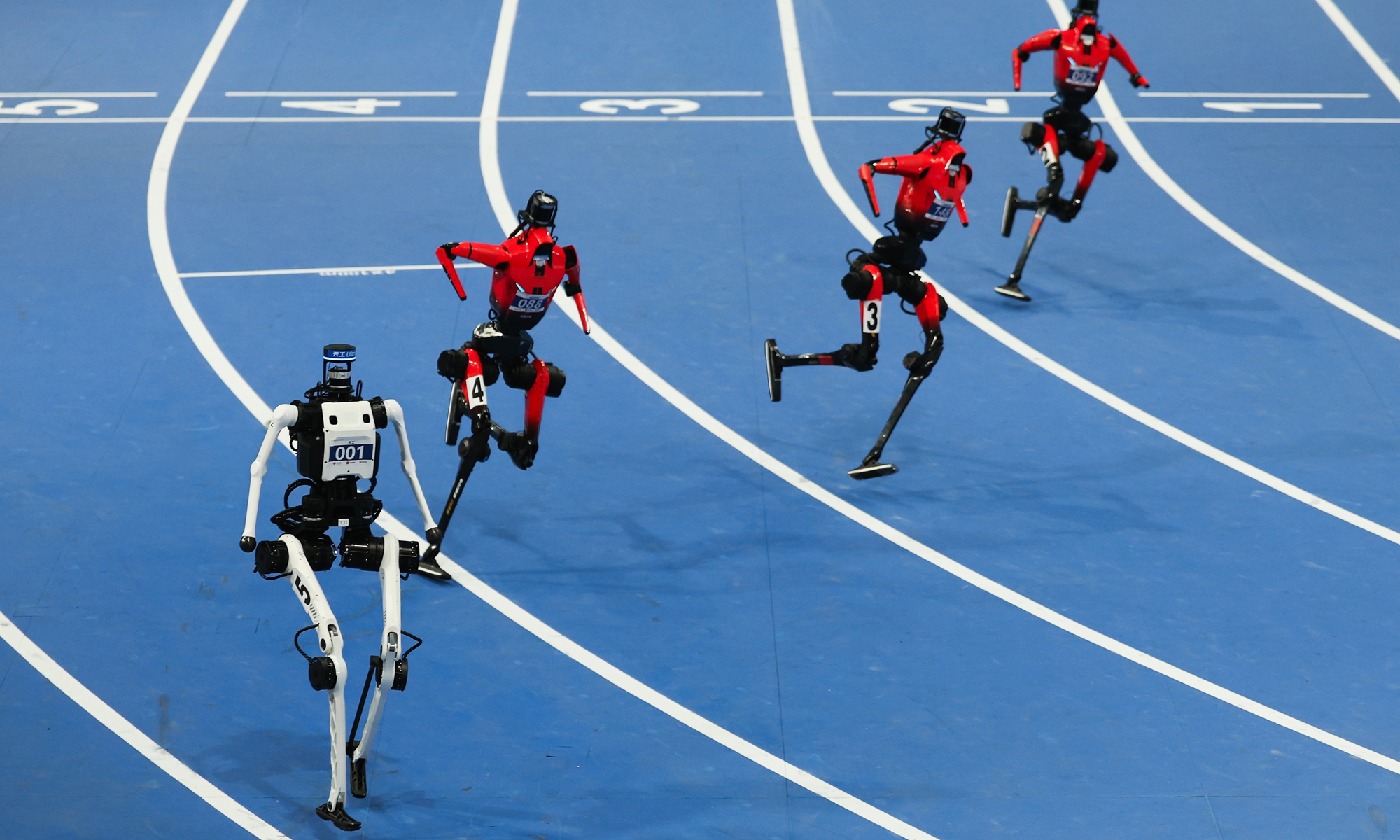
A Tien Kung robot (left) competes in the 400-meter race at the National Speed Skating Oval in Beijing on August 23, 2026 during the 2nd World Humanoid Robot Games (WHRG). Photo: VCG
On the blue track inside the National Speed Skating Oval, robots chased each other in the 400-meter race. A sprinting Tien Kung robot was tripped by a rival robot lying on the track but did not fall. Instead, it adjusted its posture in seconds and continued toward the finish line with a result of 38.15 seconds, breaking human 400-meter race world record of 43.03 seconds, held by South African athlete Wayde van Niekerk.
This scene unfolded on Sunday, the first official competition day of the 2nd World Humanoid Robot Games (WHRG). Later that evening, a humanoid robot named Lightning, developed by Honor Co., broke the long-standing human 1,500-meter world record of 3:26 set by Moroccan athlete Hicham El Guerrouj with a time of 2:30.22. Just one night earlier, during the opening ceremony's 100-meter sprint and high jump demonstrations, humanoid robots had already shattered records long held by human athletes Usain Bolt and Javier Sotomayor — merely an appetizer for the five-day sci-fi spectacle.
The Games have attracted 666 teams from 16 countries across six continents, up 138 percent from its inaugural edition. The number of participating robots quadrupled to 2,056, the Global Times learned from the organizing committee.
Yet the biggest change this year was not only the scale, but also the technological maturity. More teams have shifted from remote-controlled robots to fully autonomous systems. Chinese observers, after watching several events, said humanoid robots are no longer limited to simple demonstrations of walking or dancing. Increasingly, they are being tested in environments that demand speed, coordination, perception and decision-making.
From movement to intelligence
Behind the record-breaking performances are a series of technological upgrades. During the running events, Global Times reporters observed that robots were able to make subtle movements around their hip joints while walking, allowing them to maintain balance and produce movements closer to human biomechanics.
Guo Yijie, technical director of Tien Kung Ultra, said the improvement came from advances in hardware design.
"Robot joints have improved in torque and speed. As competitions demand higher power output, the reliability of the main control board, power board and high-power battery discharge capability have become increasingly important," Guo told the Global Times.
According to Guo, the same Tien Kung Ultra robot was used in both sprinting and jumping events. For running, the waist needs rotation to balance the inertia generated by leg movements. For jumping, the upper body requires pitching movement to help the robot achieve greater distance or height, Guo said, noting that these can all be achieved with only slight adjustments to the waist configuration were needed, and it highly demonstrated to the robot design's flexibility.
Besides the hardware upgrades, developments in robots' faster decision-making in "brains' is better showcased in football competitions.
The Booster T2 robot used by many domestic and overseas football teams has increased its onboard computing capability by 10 times compared with the previous generation. The time from recognizing the goal to deciding whether to pass or shoot has been reduced to around 100 milliseconds - faster than the time humans usually need to blink.
Cheng Hao, a technical representative from Boosters Robotics, said the improvement represents an "end-to-end" transformation in embodied intelligence.
"In the past, robots relied on separate steps: perception, planning, decision-making and execution. Each stage was disconnected. Now, with an end-to-end motion foundation model, visual input can directly generate joint control commands," Cheng said.
The newly introduced table tennis and tennis competitions are also testing another important capability: perception.
"Robots are moving from simply recognizing the three-dimensional position of a ball to understanding the movement information of opponents and more complex environments," said Li Yinghui, a postdoc researcher and the leader from the Hong Kong University team at the table tennis event. Such capabilities developed in sports scenarios could eventually be transferred to other scenarios in industries or daily life, Li said.
Beyond entertainment
Though clips from the robot competitions have made a buzz on social media, with some critics from Western media questioning why robots need to dance, play football or compete in athletics while arguing that these activities appear far from everyday needs.
Zhou Changjiu, Vice President of the RoboCup Federation and the Robotics Competition Association of the Asia-Pacific (RCAP), stressed robot sports are not designed for entertainment alone. "Robot competitions are testing the capabilities needed for humanoid robots to enter the real world," Zhou told the Global Times.
Different events evaluate different abilities. Sprinting tests speed, marathons examine battery endurance and energy management, while football provides a comprehensive test because of its dynamic and unpredictable nature, testing intelligence, manipulation, interaction, safety, cost and trust at the same time, Zhou said.
Unlike a single-task demonstration, football requires robots to cooperate. Players must understand their own roles, recognize teammates and opponents, and make collective decisions - a form of swarm intelligence that could become essential when robots work together in homes, factories and emergency rescue environments.
Entertainment, however, can generate business opportunities. Gu Jinghai, brand director of EYOU Robot Co, told the Global Times that the company sold 95,000 integrated joints in China in 2025 and expects sales to exceed 1 million units in 2026. Growth mainly comes from planetary joints used in entertainment robots, while harmonic joints for industrial robots are also expanding steadily, he said.
Jiao Jichao, an executive from UBTECH Robotics, said the criticism that "Chinese robots can only sing and dance" reflects only a temporary stage of development. "Performance and dancing are also real commercial demands, and their existence has value," Jiao said. "Beyond entertainment, Chinese robots are already demonstrating intelligent capabilities that support practical applications in manufacturing, and partnerships with companies including Huawei and Foxconn, where robots have already entered production lines in small-scale applications."
The Outline of the 15th Five-Year Plan for National Economic and Social Development of China stated that the country will construct a comprehensive cultivation system for future industries including the embody intelligence as new economic growth drivers.
Zhou said the development of humanoid robots is not only about individual machines, but about building an entire ecosystem.
China's advantage lies in its complete supply chain, abundant application scenarios and manufacturing capabilities, while the fast growing industry still faces challenges such as the lack of unified standards.
Gu said the company has launched mass production of robotics joint under domestic standard of auto parts.
Robot competitions can help address these issues by creating common standards in areas such as competition rules, robot dimensions, communication systems, batteries and joint modules. "As applications expand, the cost of key robot components will continue to decline," Zhou said.
"Numbers are magic," Zhou said. "If producing one robot costs a huge amount because it is handmade, producing one million robots will completely change the cost structure."
For humanoid robots, the race taking place inside the Ice Ribbon may not ultimately be about who crosses the finish line first. It may be about whether these machines can learn to navigate the far more complicated race outside the stadium - the race into the real world.
。
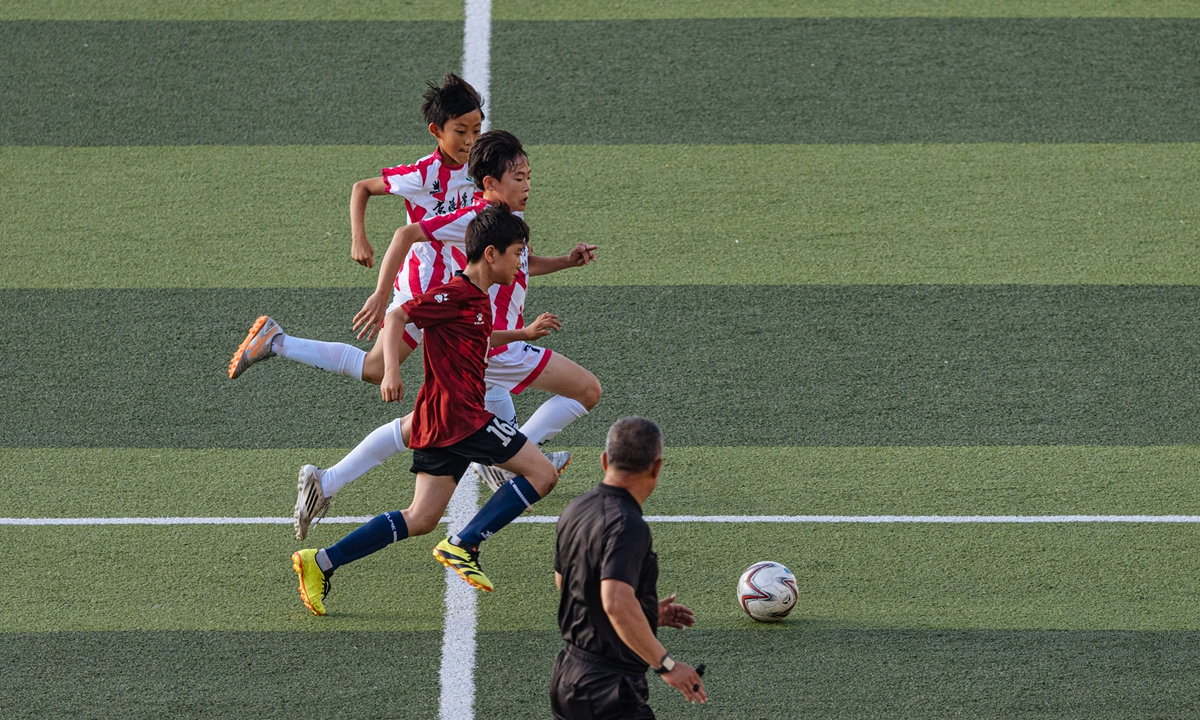
It was a busy school break. The national finals of the 2025-26 youth campus soccer league, rounds of the fifth China Youth Football League, city and provincial campus competitions, private club cups and overseas invitationals filled the calendar. Some children played close to home; others spent part of their summer travelling with teammates from one tournament to another.
The sixth 2034 Cup was among the most visible. Its 39 regional qualifiers drew 882 teams and 12,604 players, with 128 teams reaching the finals in Suzhou, East China's Jiangsu Province. Teams from other countries also took part, adding an international element to a tournament aimed at primary-school players, according to the Xinhua News Agency.
Does this crowded calendar by itself signal a turnaround for Chinese soccer? China's men last reached the World Cup in 2002. But the summer offered a view of a playing base being built from below and raised a harder question: Can the enthusiasm survive the return to school, unequal access to training and the growing costs borne by families?
From the first touch
In China's youth soccer system, coach Zhao Xinxin works at its broadest and most fundamental level - introducing young children to the game.
He coaches an introductory group of about 15 three-year-olds, three interest classes of 15 to 20 children aged five to 10, and four advanced groups of roughly 10 players aged five to 14. He has worked with more than 100 children over the years.
Starting younger is one of the clearest changes Zhao has observed in recent years. Soccer is appearing not only in schools and social clubs but also in some kindergartens. Most parents initially want an after-school activity that gets their kid moving.
Only when a player begins to stand out do questions about more advanced training and a possible route forward arise.
That route now has several layers. A child in a commercial club can move from introductory and interest classes to advanced teams. A school player may be selected for district and city teams, then enter national campus competitions; professional academies, sports schools and social clubs provide other pathways.
China began promoting campus soccer on a national scale in 2015, when six government departments issued guidelines calling for soccer to be incorporated into school education through designated soccer schools, regular competitions, teacher training and improved facilities, according to the Ministry of Education.
The program has continued to expand while shifting its focus from increasing participation to improving the quality of teaching, training and competition. In 2025, another 4,928 schools were recognized as national youth campus soccer schools, according to the ministry.
The result is more soccer on the calendar. Zhao told the Global Times that youth matches take place somewhere in Beijing almost every week, especially during school holidays. His club's advanced teams play weekend fixtures with referees and standings, as well as regional competitions and finals.
Tournaments such as the 2034 Cup give this broad base a visible target. Soccer commentator and youth-project organizer Dong Lu launched the event in 2021 after repeatedly seeing Chinese social media celebrate Japan's high-school soccer tournament. Its name looks toward the 2034 World Cup, when the first group of participants will be about 25.
Earlier this summer, a team selected through Dong's youth soccer project offered another source of encouragement. The Chinese Football Boy U12 team won all seven matches at the Sigismondi International Youth Cup in Italy, becoming the first Asian team to claim the championship.
Yet Dong cautioned against reading too much into a single championship. Strong players, he said, must emerge from a much broader soccer culture. "Players come from the people around us, from the soil and culture in which they grow," he told the Global Times.
Who can keep playing?
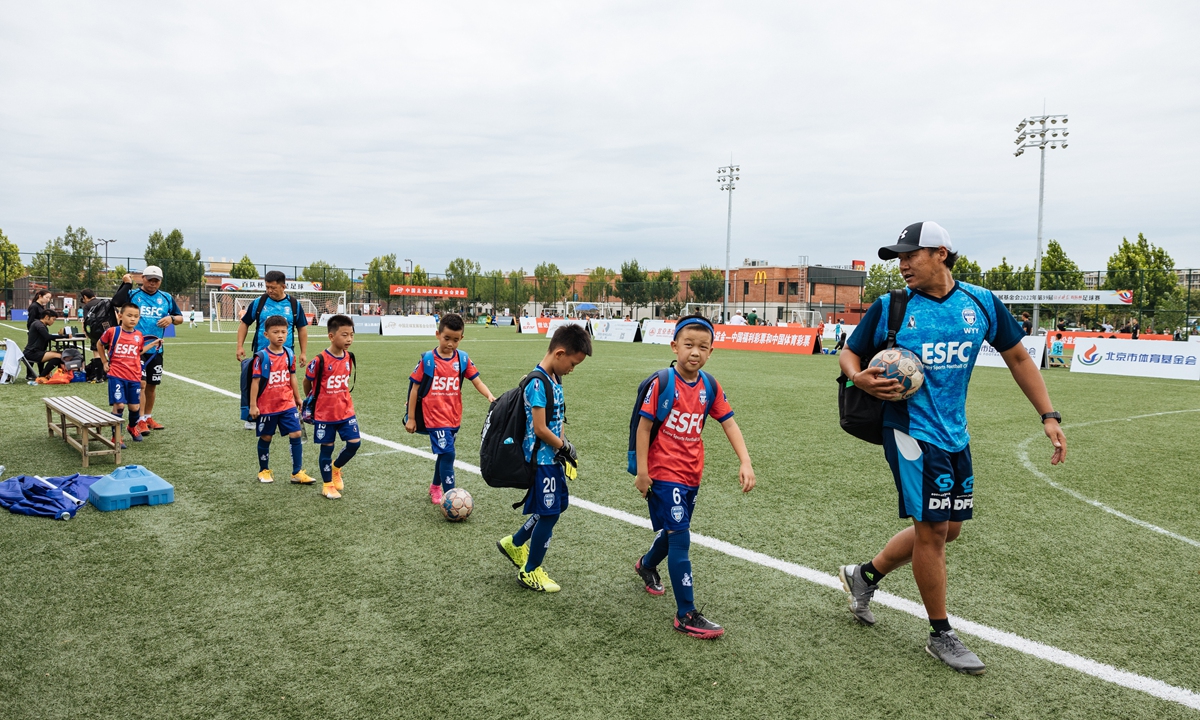
For Zhao, the first major break comes at 12. Children may train throughout primary school, then stop after entering middle school as homework, examinations and family expectations take over - a pattern he calls "retiring at 12."
Campus soccer should be the main way to keep the player pool broad, he said, because school is where nearly every child spends most of the day. More schools now provide soccer classes and in-class competitions, but implementation varies.
Zhao recalled a class tournament in which a child was injured. After a parent complained, the remaining matches were cancelled. Safety concerns are understandable, he said, but cancelling competition altogether removes opportunities from every child.
For families, this is also the stage when soccer stops being a simple extracurricular activity. If a child has shown unusual ability, parents must decide whether to seek stronger teams, change schools, accept more travel and training, or keep soccer only as an interest. The decision depends not only on talent and the child's wishes, but also on educational expectations and how much time and money the household can commit.
The contrast with Europe lies partly in continuity. Zhao cited his nephew in Hungary, who trained at a Barcelona-affiliated academy between the ages of six and eight before being selected by a local club at nine.
Once children join organized training there, he said, they are registered at relatively low cost, and their movement between clubs is recorded in the soccer association's system - closer to transferring schools than simply leaving one commercial course for another.
Dong made a broader comparison. Japan's national team increasingly draws on players who have further developed further in European leagues, while China still relies mainly on its domestic league to prepare future internationals.
In his view, the two systems operate like production lines with different competitive standards. Young Chinese players therefore need more high-level matches, whether foreign teams come to China, Chinese teams travel abroad or selected players enter overseas leagues.
But overseas training cannot substitute for a domestic system, nor is it open to every family. Zhao said it requires ability, physical readiness, money and the capacity to adapt to a different language, diet and daily life. Some parents send a child abroad; others move with them, reorganizing work and family life around soccer without knowing whether the child will ever turn professional.
For now, the most telling test may come not in 2034, but this coming September, when a child enters a new grade and decides whether there is still time in the week for soccer.
。
Current article:http://www.hanninhuaxituochunkui.pics/list_lbx3j/m46w9h.pptx
Published on:18:04:22


1
再无前沿和后方!乌军获得英国导弹技术!但是为何说却难以翻盘?,兵器志,原创 再无前沿和后方!乌军获得英国导弹技术!但是为何说却难以翻盘?2
李显龙接班人即将上台,要求美国停止打压中国3
LinkedIn机器人大战抹掉了一半的苹果员工账号4
锚定“两地一中心”,2030年突破2万亿 杭州服务业扩能提质“路线图”出炉5
多款全新 Fallout 76 Funko Pop 玩偶将于 11 月推出,包含避难所小子、核子可乐女孩等6
杭州机场全面恢复航班运行7
「検討しているかも」ドジャース、佐々木朗希放出の新たなトレード説が浮上!? 米メディア「有力な選択肢と」8
Oppo正式发布光域屏幕指纹识别技术(带视频演示)9
China's private space sector launches AI-powered satellites as commercial push gathers pace10
苹果计划补贴老苹果手表用户11
UK ex-pilots helping Chinese military?12
Number_i、米エージェントと契約も「成功は至難の業」待ち受ける“高いハードル”超えたBTS13
Turkey to Conduct Operation 'Understandable' to International Community in Syria, Erdogan Says14
轰31分制胜!中国女排19岁1米87重炮崛起:赵勇栽培又一新星?15
海南通报“3个小孩被锁家里”:其父母共生5个小孩,父亲正在服刑
- 随机推荐
1
Congress presidential polls underway2
宝马高管:宝马正改进三缸到八缸发动机 燃油发动机研发仍会继续3
极氪发布最新概念车0.01:6岁孩童操刀设计4
美加贸易战进一步升级!特朗普:明年将加拿大汽车、钢铁等品类关税提高至50%5
米切尔自曝食谱:每天7-8瓶运动水&健康饮食 最难戒的是小熊软糖6
广东抢修恢复100多万用户供电7
韩国警方进入总统官邸内部 越过第一道拦阻线8
Economic warfare and maximum pressure only further fuel conflicts, FM spokesperson responds to Bessent’s global warning on Iran financial ties9
东家蒸蒸日上 C罗意欲何往?10
从699美元起,Microstar Infinite推出了“轻追击”游戏主机:i5/i7 RTX 206011
绥中荒地镇提升人居环境12
济南新学期周历发布!秋季开学时间为9月1日,2027年寒假、暑假时间也明确了13
多名中石油干部甘愿落入政治骗子陷阱 细节披露14
开封购彩者中得顶呱刮“十倍幸运”一等奖15
手搓电影《目不转睛》将上映!导演放话票房破亿送粉丝10台宝马