
命中注定我爱你
China's World Cup hopes begin with children taking the field. What's next?_我的网站

A |
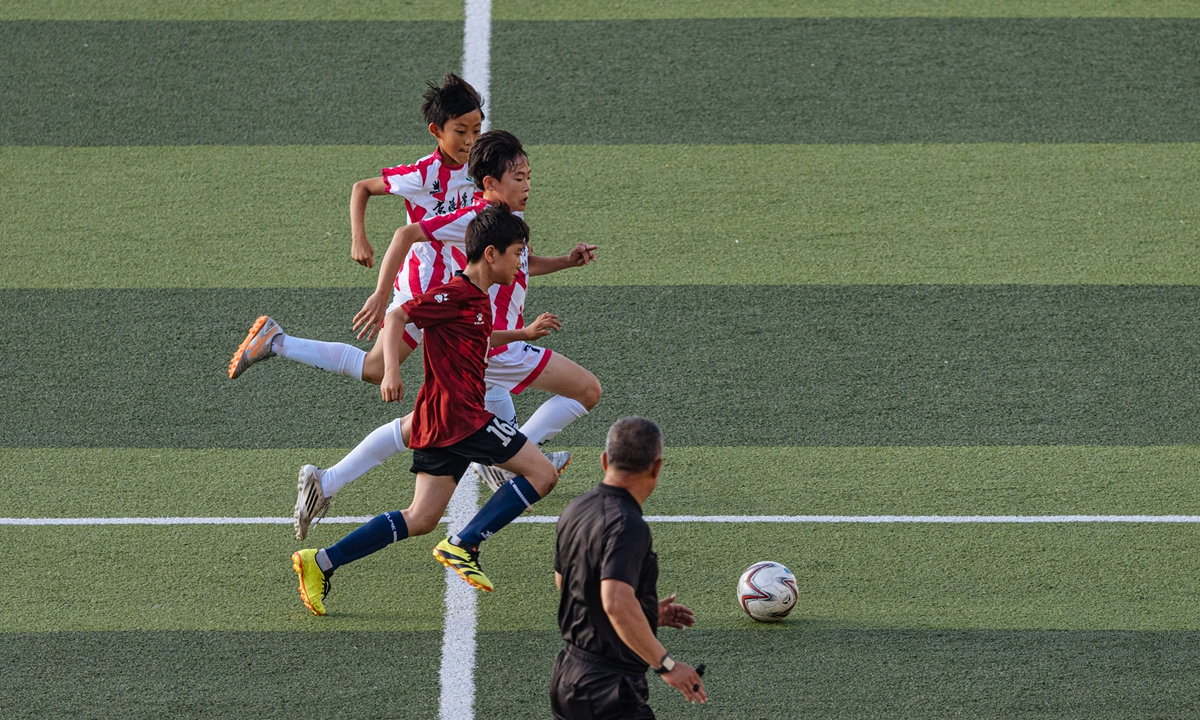
It was a busy school break. The national finals of the 2025-26 youth campus soccer league, rounds of the fifth China Youth Football League, city and provincial campus competitions, private club cups and overseas invitationals filled the calendar. Some children played close to home; others spent part of their summer travelling with teammates from one tournament to another.
The sixth 2034 Cup was among the most visible. Its 39 regional qualifiers drew 882 teams and 12,604 players, with 128 teams reaching the finals in Suzhou, East China's Jiangsu Province. Teams from other countries also took part, adding an international element to a tournament aimed at primary-school players, according to the Xinhua News Agency.
Does this crowded calendar by itself signal a turnaround for Chinese soccer? China's men last reached the World Cup in 2002. But the summer offered a view of a playing base being built from below and raised a harder question: Can the enthusiasm survive the return to school, unequal access to training and the growing costs borne by families?
From the first touch
In China's youth soccer system, coach Zhao Xinxin works at its broadest and most fundamental level - introducing young children to the game.
He coaches an introductory group of about 15 three-year-olds, three interest classes of 15 to 20 children aged five to 10, and four advanced groups of roughly 10 players aged five to 14. He has worked with more than 100 children over the years.
Starting younger is one of the clearest changes Zhao has observed in recent years. Soccer is appearing not only in schools and social clubs but also in some kindergartens. Most parents initially want an after-school activity that gets their kid moving.
Only when a player begins to stand out do questions about more advanced training and a possible route forward arise.
That route now has several layers. A child in a commercial club can move from introductory and interest classes to advanced teams. A school player may be selected for district and city teams, then enter national campus competitions; professional academies, sports schools and social clubs provide other pathways.
China began promoting campus soccer on a national scale in 2015, when six government departments issued guidelines calling for soccer to be incorporated into school education through designated soccer schools, regular competitions, teacher training and improved facilities, according to the Ministry of Education.
The program has continued to expand while shifting its focus from increasing participation to improving the quality of teaching, training and competition. In 2025, another 4,928 schools were recognized as national youth campus soccer schools, according to the ministry.
The result is more soccer on the calendar. Zhao told the Global Times that youth matches take place somewhere in Beijing almost every week, especially during school holidays. His club's advanced teams play weekend fixtures with referees and standings, as well as regional competitions and finals.
Tournaments such as the 2034 Cup give this broad base a visible target. Soccer commentator and youth-project organizer Dong Lu launched the event in 2021 after repeatedly seeing Chinese social media celebrate Japan's high-school soccer tournament. Its name looks toward the 2034 World Cup, when the first group of participants will be about 25.
Earlier this summer, a team selected through Dong's youth soccer project offered another source of encouragement. The Chinese Football Boy U12 team won all seven matches at the Sigismondi International Youth Cup in Italy, becoming the first Asian team to claim the championship.
Yet Dong cautioned against reading too much into a single championship. Strong players, he said, must emerge from a much broader soccer culture. "Players come from the people around us, from the soil and culture in which they grow," he told the Global Times.
Who can keep playing?
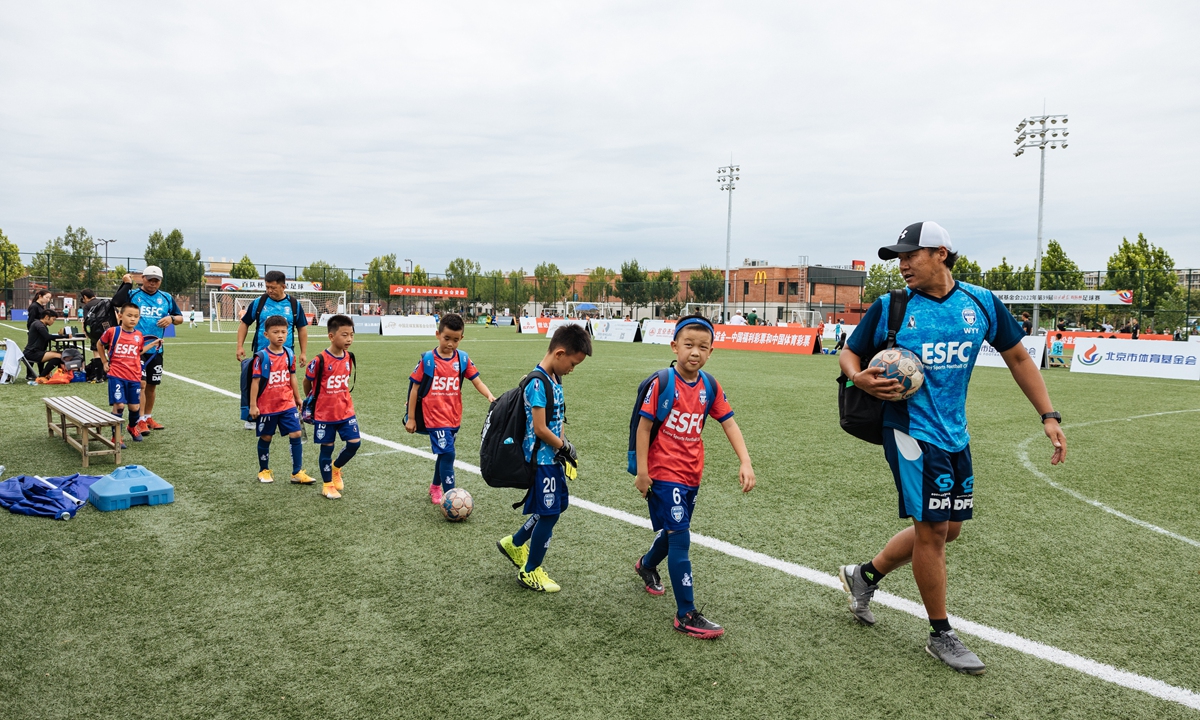
For Zhao, the first major break comes at 12. Children may train throughout primary school, then stop after entering middle school as homework, examinations and family expectations take over - a pattern he calls "retiring at 12."
Campus soccer should be the main way to keep the player pool broad, he said, because school is where nearly every child spends most of the day. More schools now provide soccer classes and in-class competitions, but implementation varies.
Zhao recalled a class tournament in which a child was injured. After a parent complained, the remaining matches were cancelled. Safety concerns are understandable, he said, but cancelling competition altogether removes opportunities from every child.
For families, this is also the stage when soccer stops being a simple extracurricular activity. If a child has shown unusual ability, parents must decide whether to seek stronger teams, change schools, accept more travel and training, or keep soccer only as an interest. The decision depends not only on talent and the child's wishes, but also on educational expectations and how much time and money the household can commit.
The contrast with Europe lies partly in continuity. Zhao cited his nephew in Hungary, who trained at a Barcelona-affiliated academy between the ages of six and eight before being selected by a local club at nine.
Once children join organized training there, he said, they are registered at relatively low cost, and their movement between clubs is recorded in the soccer association's system - closer to transferring schools than simply leaving one commercial course for another.
Dong made a broader comparison. Japan's national team increasingly draws on players who have further developed further in European leagues, while China still relies mainly on its domestic league to prepare future internationals.
In his view, the two systems operate like production lines with different competitive standards. Young Chinese players therefore need more high-level matches, whether foreign teams come to China, Chinese teams travel abroad or selected players enter overseas leagues.
But overseas training cannot substitute for a domestic system, nor is it open to every family. Zhao said it requires ability, physical readiness, money and the capacity to adapt to a different language, diet and daily life. Some parents send a child abroad; others move with them, reorganizing work and family life around soccer without knowing whether the child will ever turn professional.
For now, the most telling test may come not in 2034, but this coming September, when a child enters a new grade and decides whether there is still time in the week for soccer.
。

B | 昨日立秋,但立秋不等于入秋,气象学上要连续5天日平均气温≤22℃才算入秋,杭州离真正的秋天还很远。不过,受台风“白海豚”影响,持续近一个月的暑热有望得到暂时缓解。截至昨天,杭州从7月14日以来的这波连续高温已达25天。随着“白海豚”的靠近,高温将暂时退场。杭州今天白天阴有阵雨或雷雨,雷雨时局地可伴有短时暴雨和7~9级雷雨大风,夜里阴有中到大雨,白天最高气温34℃。

C | 明显的降温从明天开始,杭州最高气温有可能降到30℃以下。昨天省防指将防台风应急响应提升至Ⅲ级,杭州市防指也启动防台风Ⅳ级应急响应。台风将带来风雨影响,提醒大家做好防范,可以做适当的准备:适量备些耐放的食品和饮用水,以备不时之需;花盆、衣架、晾衣杆收到室内,门窗也要检查一下;关注相关部门的预警,尽量少出门。

D | “白海豚”面积相当于13个浙江可能9日下午到10日在我省登陆即将登陆我国的“白海豚”是一个耐力型台风,生成已超10天,经历了5次眼壁置换,3次加强为超强台风。中国天气网气象分析师沈雨旸介绍,从昨天早上的云图上看,“白海豚”结构完整,眼区仍比较清晰,由于有干冷空气卷入,西侧环流减弱,眼区附近出现大片空心区,不过整体环流变得更大了,面积近似13个浙江省那么大。

E | 据中央气象台,今年第13号台风“白海豚”(强台风级)的中心昨天20时位于浙江省温州市以东大约660公里的西北太平洋洋面上,就是北纬27.2度、东经127.3度,中心附近最大风力有14级(45米/秒),中心最低气压为950百帕,七级风圈半径为420~450公里,十级风圈半径为220~250公里,十二级风圈半径为100公里。据浙江省气象服务中心昨天的预计,“白海豚”将以每小时10~15公里的速度向偏西方向移动,可能于9日下午到10日早晨在苍南到象山一带沿海登陆(台风级或强台风级,12~14级),登陆后缓慢西行。中国天气网提醒,登陆后,“白海豚”还将深入内陆,给浙江、上海、江苏、福建、江西、安徽、湖北、湖南、河南、山东等十余省份带来风雨影响。为应对“白海豚”带来强降雨可能出现的汛情,水利部7日18时对上海、江苏、浙江、安徽、福建、江西启动洪水防御Ⅳ级应急响应。“白海豚”将给浙江带来5天的降雨明起杭州最高气温有望降至“2字头”浙江省气象服务中心称:受“白海豚”影响,昨天下午起,浙江沿海海面和沿海地区风力逐渐增强至8~10级,昨天夜里至10日增强至10~13级,其中9日白天至10日上午局部13~16级。

F | 内陆地区9日至10日大部分地区最大风力8~10级,高山区和江河湖面局部11~12级。

G | 这次“白海豚”给我省带来的降雨时间长达5天(7日夜里至12日),强降雨主要集中在8日夜里至10日,东部、南部地区累计雨量大,单点有极端性。

H | 预计今天白天沿海部分地区有大到暴雨,局地大暴雨;今天夜里至10日浙中南和沿海地区有暴雨大暴雨,台州、温州和宁波南部局地有特大暴雨;11日浙西部分地区暴雨,局地大暴雨。杭州市气象台称,“白海豚”登陆后移速慢、影响时间长,造成的风力影响和“巴威”相当,但降雨比“巴威”更强。预计8日至12日杭州有较明显风雨过程,降雨最强时间段集中在9日至10日。8日白天起全市风力逐渐增大,最强时段出现在9日白天到10日上午,最大东北风平原地区8~10级,山区和江湖水面局地11级以上。携风雨而来的“白海豚”将带来明显降温。

I | 浙江省气象服务中心预计,今天起高温开始收敛,9日至12日基本“偃旗息鼓”,届时我省大部分地区最高气温将降至28~30℃。杭州市气象台说,明天开始,“白海豚”的影响趋于明显,气温进一步回落。预计9日至13日,杭州主城区最高气温在28~30℃。
Current article:http://www.hanninhuaxituochunkui.pics/list_xv9z1/44t.htm
Published on:11:52:57