调解面对面
US smears China’s Huangyan Dao nature reserve amid Philippine provocations; Washington’s verbal backing offers no real support, fuels tensions: expert_我的网站

A |
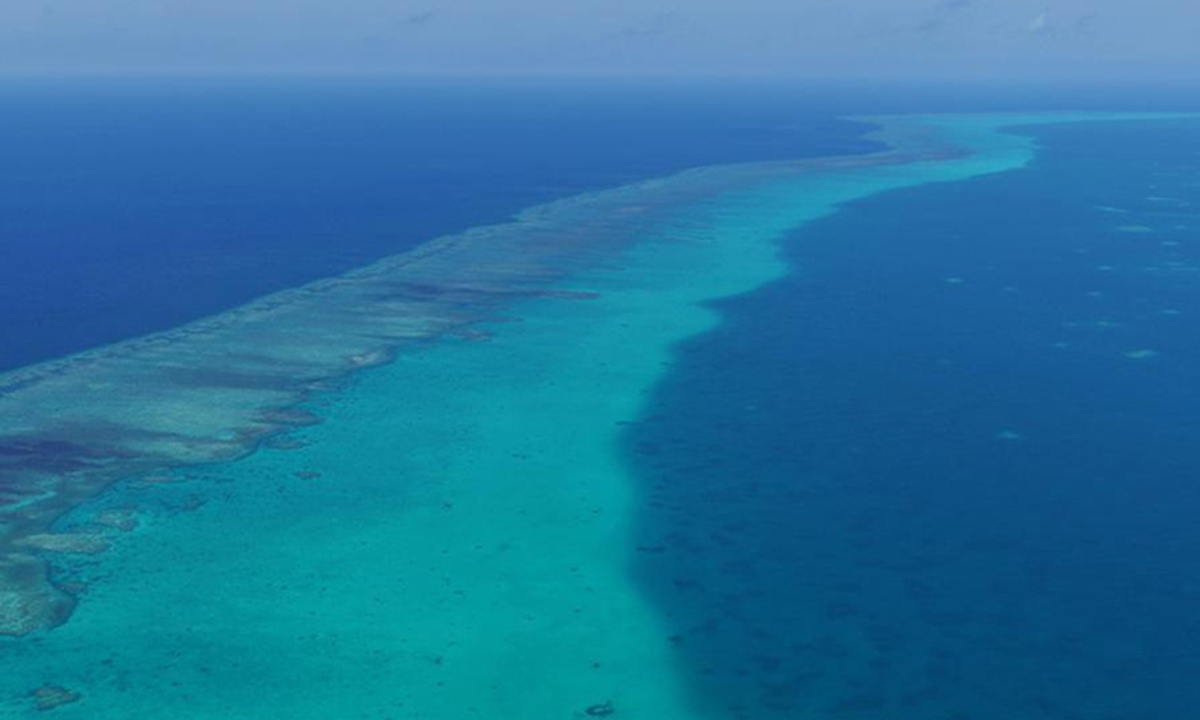
An aerial drone photo taken on May 2, 2026 shows reefs in the territorial waters of China's Huangyan Dao in the South China Sea. Photo: Xinhua
Amid a new round of Philippine hype over its so-called territorial claims involving China's Huangyan Dao, the US State Department on Saturday, in a statement, smeared China's Huangyan Dao National Nature Reserve as "destabilizing" and pledged support for its ally. A Chinese expert said Washington is encouraging Manila to disrupt regional peace while offering little more than hollow verbal assurances, further undermining stability in the South China Sea.
The statement, published on the State Department's official website and attributed to spokesperson Thomas Pigott, claimed that the US "rejects China's ongoing attempts to enforce its destabilizing 'national nature reserve'" at Huangyan Dao.
Pigott also alleged that the reserve would "deny Filipino fishermen access to their traditional fishing ground as reflected in the 2016 Arbitral Award."
It is absurd for the US, a country that is not a party to the United Nations Convention on the Law of the Sea (UNCLOS), to pass judgment on the Huangyan Dao National Nature Reserve, Yang Xiao, a research fellow at the Institute of Peaceful Development under the Chinese Academy of Social Sciences, told the Global Times on Sunday.
The US has neither jurisdiction in the South China Sea nor the standing to judge regional affairs. Its allegation of the reserve at this time is merely intended to echo the Philippines' latest hype surrounding Huangyan Dao, Yang said.
At a time when the broader China-US relationship is moving toward an easing of tensions, attempts by certain US officials to encourage provocations out of narrow political interests run counter to the overall trend, Yang said.
Pigott further smeared the reserve as "another unilateral attempt by China to use dubious environmental and legal pretexts," which he claimed was intended to advance China's territorial and maritime claims in the South China Sea "at the expense of its neighbors."
"The United States stands with our Ally, the Philippines, in support of a free and open Indo-Pacific," Pigott claimed.
The expert added that the statement also invoked the unlawful and invalid 2016 "South China Sea Arbitral Award" as a pretext, seeking to portray China as a destabilizing force in the region and mislead the international community.
The US statement comes as Manila has sought to advance its claims over Huangyan Dao through various means, including by delimitation of the so-called "baselines of the territorial sea" of the Chinese territory of Huangyan Dao. The Chinese Foreign Ministry on July 31 described the move as "illegal, null and void."
Yang said that amid a broader retrenchment of its global strategy, the US is seeking to encourage countries including Japan and the Philippines to stage regional provocations and disrupt stability. Such tactics include organizing joint military exercises and tolerating provocative actions by Manila in the South China Sea.
However, Washington is no longer capable of offering the Philippines substantive support and can provide little more than rhetorical backing, Yang said. Such statements amount to words on paper and have no practical effect, he added.
China's State Council approved the establishment of the Huangyan Dao National Nature Reserve in September 2025. China has since conducted multiple scientific surveys in the area.
On August 1, China issued management measures for the reserve, prohibiting unauthorized fishing and mining, the harvesting or excavation of corals, coral reefs and giant clams, as well as other activities that damage rare marine species or the reserve's natural ecosystems.
China has also discovered a globally rare coral reef growth structure-type marine blue hole at Huangyan Dao. Preliminary geochronological analyses suggest that the blue hole formed at least 3,200 years ago, while surveys have found rich biodiversity in its surrounding waters. The finding is considered further evidence of the effectiveness and necessity of China's ecological protection measures at Huangyan Dao.
。 您有没有碰到过这种情况:出门想要乘坐地铁,刷了卡进了站,结果还没上车,发现忘带了东西要回去取,可是再刷卡同一站点甚至同一个闸机出去,就被扣了三块钱。虽然不是什么大钱儿,但这明明自己还没“起步”,可是地铁“起步费”却先收了,心里或多或少还有点儿别扭。 其实类似的情况还有不少,比如有人进错了站,有人走错了地铁出口,还有人在半途中需要上厕所,而厕所在扣费闸机之外等等。同站进出,并未乘车,却被扣费,有公众对此提出异议,认为地铁这样的规定不合理。 近期,上海地铁的一项新规引发关注:乘客临时有需求在同一站点进出,只要时间在10分钟以内,可至车站服务中心进行人工处理,就可免去3元钱的费用。这一人性化的规定,赢得了很多市民和网友的点赞。这种做法值得不值得提倡?是不是应该成为各个城市的“地铁标配”呢? 先来看看上海地铁为何会出台这项同站进出"限时免收费"新规?它其实源于一位大学生发起的维权诉讼。一起来了解下。 大学生罗雨洁在上海徐家汇地铁站出站时发现走错了出口,她再次刷卡进站,又在徐家汇地铁同站不同出口刷卡出站,而这趟“寻找出口”的过程被扣除了3元“乘车费”。小罗认为,地铁短时间“同站进出”扣费的规则并不合理,且没有尽到提示、说明义务。之后,她和同学在上海市主要地铁枢纽站进行了调研,发现不同地铁站的工作人员操作不同,解答也不一致,而且在上海地铁站官网,小罗也没有查找到关于“同站进出”的收费依据。

B | 去年7月,小罗将上海地铁运营公司诉至法院,请求法院判决确认该公司的“0公里票价为3元”为无效格式条款,并请求法院判令地铁公司返还车费3元,上海市铁路运输法院受理了此案。

C | 随后,在调解过程中,上海地铁公司委托诉讼代理人向小罗说明了解决案涉票务问题的举措。

D | 最终小罗同意调解,并撤回了起诉,上海地铁退回小罗3元钱车费。 华东政法大学学生
罗雨洁:其实我们是支持短时间内同站进出不收费,但是我们不支持“同站进出”不收费,因为会导致一些逃票事情发生。比如说他可以从一站坐到另一站再坐回来,如果没有时间限制的话,他这样再坐回来,那也是不收费的,这样就不是特别合理。 前不久,上海市地铁官方网站的“票务处理说明”栏进行了更新,明确“乘客进站10分钟内取消乘车的,出站前需主动至本站服务中心办理;超过10分钟或非本站进站不予受理。

E | ”乘客原本需要支付3元的同站进出费用,就此调整为“0元”。

F | 内地55个城市开通轨道交通覆盖约3亿人口 看来,这一人性化的规定,也赢得了很多市民和网友的点赞。那么其他城市做得怎么样呢?据交通运输部公布数据,截至去年底,我国内地共有55个城市开通运营城市轨道交通,覆盖我国约3亿城区人口。以地铁为代表的城市轨道交通,成为城市居民出行的重要工具。那么全国是不是很多地方都存在同站进出扣费的情况呢?我们的记者对这55个城市的轨道交通规则进行了梳理后发现,目前仅有苏州、上海、杭州三地公示了乘客刷卡进站后取消乘车的该如何进行处理,其他城市关于“同站进出”如何收费,政策不一。

G | 同站进出地铁如何收费各地政策尚不统一 《苏州轨道交通票务规则》在2023年6月更新版中明确: 乘客进站10分钟内取消乘车的,出站前需主动至本站客服中心办理免费更新或者退票业务; 超过10分钟或非本站进站不予受理。 《杭州地铁票务规则》在2023年12月更新版中注明: 乘客进闸后10分钟内取消乘车的,出闸前需主动至进闸站客服中心办理,超过10分钟的不予受理。 记者又分别致电一些尚未在票务规则中就“同站进出”地铁如何收费的城市地铁服务热线,查询“同站进出”地铁能否退费,各地反馈的政策不一。 进地铁站上个厕所要付费? 也有一些城市的地铁客服人员提到,不少乘客进站其实是想用卫生间,但尴尬的是,有些城市地铁站里的卫生间是在收费区。这才导致有人买票进站“付费”上厕所。针对这种情况,一些地方也尝试服务改革,将地铁资源共享给更多市民。 据记者梳理,郑州、洛阳、青岛、西安、武汉、昆明、合肥、石家庄、常州、金华等地轨道交通已经开展“公厕共享”服务。在洛阳地铁1号线和郑州地铁2号线的站台服务中心,记者都见到了类似的“便民服务卡”。车站工作人员表示,市民游客不需支付地铁进站费用,只需要借用此卡,便可以进站如厕。 郑州地铁2号线工作人员
王晓茹:比如说乘客他在站外不想乘车,但是他有使用卫生间的需求,也是为了资源共享,然后会给乘客提供一些便利。 地铁运营正经历从“管理至上”到“服务至上” 有研究交通领域政策的学者表示,地铁运营方关于“同站进出”是否收费、如何收费,正经历着从“管理至上”到“服务至上”的演变。“管理至上”基于地铁运营方管理的便利度,而“服务至上”则体现着将乘客利益最大化摆在首位。 中国政法大学法与经济学研究院教授 张卿:我觉得这确实体现了从“管理至上”到“服务至上”。 东南大学交通法治与发展研究中心执行主任
顾大松:我觉得“同站进出”免费的确是个好事。但是一定要有一个规则,用一些标准规范来引导,比如说像国家标准。甚至在国家标准的基础上,有一些地方的规则、更好的地方标准,通过科学的标准来引导;第二个方面,允许公众更多地参与(合规性探讨),来推动。

H | 使得我们一些友好型的一些公共基础设施进行调整、改善。 (总台央视记者 梁铮铮 马力 洪臻妍 夏周周 杨滢)。
Current article:http://www.hanninhuaxituochunkui.pics/sh6jd0x/20260826/2000362.pptx
Published on:16:39:49
